
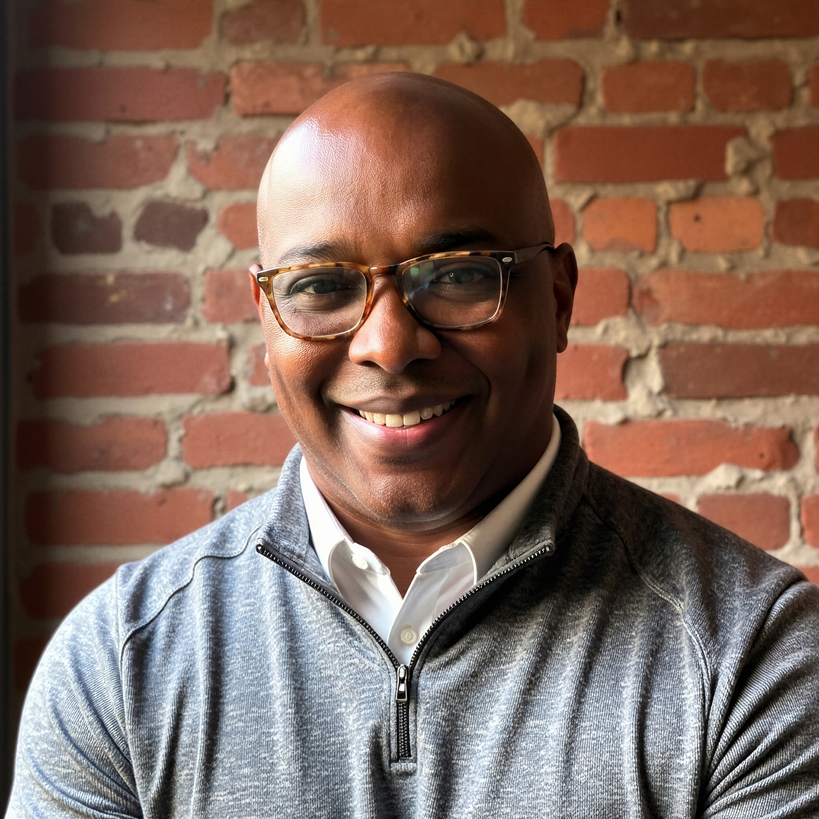
Dr. Erriel Roberson is an educator, social justice advocate for people of African ancestry, world traveler, and author of his debut science fiction/fantasy novel Forever People. Erriel’s love of authentic narratives that free the imagination and reframe the world, as well as his hunger for social justice, led him to write Forever People and launch the Exordium series of which it is a part.
While he hasn’t time-traveled like his protagonist, after living throughout the US and England as a child, Erriel Roberson has traveled as an adult from London to Morocco, Egypt, Barcelona, the Arctic Circle, fantastical worlds in his own mind, and many other places in between. A Doctor of Educational Psychology, he has applied his formal training to deeply layered character development and detailed world-building.
Equally comfortable reading science fiction/fantasy or pumping iron in the gym, Erriel is a lifelong science nerd and former collegiate athlete. He brings a unique and vibrant mental and physical energy to his writing and speaking. Erriel lives and works from his home in Maryland.
BPM: How did you begin your writing career? When were you first published?
I began my writing career 33 years ago, writing Afrocentric non-fiction. I was published by a small press in Maryland in 1993. I lectured around the country making the case for self-determination, healing, and reconnecting with our African heritage. I even did some work in Senegal, West Africa. Realizing that the number of people I could reach with this intellectual (non-fiction) approach was limited, I pivoted. My pivot was also in part to raise and protect my three children, which my wife and I did successfully. All three are now well-adjusted adults, aware of who and whose they are.
My transition to writing fiction was inspired by the impact that writers like Toni Morrison, Ayi Kwei Armah, Sondra Jackson-Opoku, Nnedi Okorafor, and many others had on my thinking about fiction and its power to effect change in people’s minds while still entertaining them. In the world of Afrocentric non-fiction, I did deep dives into books like Assata Shakur, Soledad Brother, The Miseducation of The Negro, and writers like Dr. John Henrik Clarke, Dr. Marimba Ani, Ivan Van Sertima, Na’im Akbar, Asa Hilliard, Chancellor Williams, Cheikh Anta Diop, and many others. So, I went from self-publishing in 1996 and starting an independent press to publish my work and others’ to self-publishing again in 2026, with my children grown and out of the house. Those early days in the 90s still impact my writing today.
BPM: How did your upbringing or personal experiences influence your storytelling style?
There is a lot of my lived experience in Forever People. I was born in a small town in Louisiana about an hour north of New Orleans. That alone is fertile ground for seeing the world a little differently, which I was able to do since my father was in the Air Force and we traveled and lived around the world. I saw the reality of the world for people of African ancestry while at the same time seeing that oppression was not all there was as we traveled around the country and the world.
BPM: What does writing give you that nothing else does?
Writing has given me the opportunity to expand the limits of my imagination. At times, I have recognized it has been challenging as I grappled with imagining a future very different from our current reality. I had to extricate myself from a constrained imagination. Writing has also been therapy as I have been able to safely explore what I call, or my characters in Forever People call, the Pain Place. For me, it represents that place where we stash away the hurts and trauma we experience so that we can at least function and live productively. Writing also has allowed me to visit my Pain Place and engage in the healing work that so many people have not been able to engage in.
Additionally, where there is no joy, writing has been the easiest way for me to fashion a reality where there is abundant joy; a joy that comes from being healthy and winning, since we essentially are still living in the land of our ancestors’ captivity, which can be very heavy. And we have not been given “permission” to heal in America.
BPM: Introduce your latest work and the main characters. Why did this story need to be told now?
Forever People is a celebration of the resilience and excellence of African people. Brian and Shannon, my two protagonists, are both physicists, so we start from a place of achievement and pride. They also accomplish something no one else in the world has been able to: they marry their scientific brilliance with ancestral memory, healing, time travel, and the power to create a future.
Probably as important is that both of these characters transform in this story and take new names and titles as they find their way along their journeys. A profound psychological statement is being made in their transformation, as well as their physical ability to traverse time and dimension. The story is told with “us” as the subjects of our own triumphant narrative, not as objects in someone else’s narrative. This is powerful!
I am especially excited about seeing people of African ancestry in love, sharing intimacy and friendships (men), taking full hold of shaping a future that we determine, and WINNING! This is not a sorrowful homage to our past, though there is still a place for that in literature. Rather, it is an exploration of what health and power look like for our people.
The world today, especially in America, has dictated the necessity of stories like this, which is why I felt an urgency to write Forever People, as an attempt is being made to literally erase us; but we are FOREVER!
Forever People is the first book of a duology that might be expanded into a longer series. The second book has a working title, People of the Promise. It explores the world that has changed and the people that have changed because Brian answered his calling in Forever People. It is a deeply layered and fast-moving exploration of futures yet to be explored.
BPM: What’s something about the book that readers won’t find in the description or the blurb?
Readers will be pleasantly surprised by the tenderness and love between characters in this book. I know it is something I have yearned for more in literature, and particularly in films. Healthy and committed Black love is abundant in Forever People. It is not just between the married protagonists but also about profound, committed, intimate friendships among many of the characters.
BPM: What’s one personal truth you discovered about yourself while writing this book?
I discovered that I have an appetite for vengeance! It seems that everyone is allowed to talk about revenge except for people of African ancestry. But writing allowed me to explore visiting a little “get back” on people who had in mind stealing, killing, and destroying in both the past and present. It was liberating to write about! Not everything can and should be cloaked in forgiveness for us. There is a place and time when our lives demand a vociferous defense and an accounting for attempts to extinguish them. Literature is replete with this idea. Toni Morrison’s Song of Solomon and The Seven Days gave me permission to go there.
BPM: What fears, if any, did you push through to finish this project?
I think, like most writers, I had a fear of whether I was indeed good enough to expect that anyone would want to read my writing. Was I wasting a lot of time writing a 406-page epic novel? I still struggle with self-doubt on many occasions.
BPM: Writing is often romanticized. What’s a reality about this life that most people don’t see?
Writing is demanding mentally. It takes critical thinking and endurance to craft a story and then go back and research, rewrite, revise, expand, and keep going. It also takes organization and commitment to finish, because even though I love the story I have told, there were times when I fell out of love with the process and the story, but I had to keep pushing through.
BPM: What other art forms feed your creative soul?
I LOVE music and film. I am a product of the 80s and 90s. Conscious rap was responsible for my initiation into learning my history and cultivating a mind of resistance to what others said about me and my people. From artists like Public Enemy, X-Clan, Poor Righteous Teachers, and Bob Marley to the Fugees, Outkast, Goodie Mob, Arrested Development, and so many others, I developed a taste for freedom! Music has had a tremendous impact. I also love movies where Black people love, resist, and ultimately win! Black Panther, Love Jones, The Photograph, The Woman King, Alice, Antebellum, and so on. Far too few, but I love those films!
BPM: How can readers connect with you, and what’s the best way for them to support your work?
I am on social media: Instagram, Facebook, and I welcome connections and conversations. I am not just about followers or clowning for views. That is not where I am. I am not a person who will do anything for money.
So if readers want to connect with me, I will respond and value the interaction. I also have a website that I would love people to visit and get connected with me. I cherish substantive, meaningful relationships with readers, not just sales.
Website: www.errielroberson.com
Instagram: www.instagram.com/errielroberson
Facebook: www.facebook.com/erriel.roberson
Available on Amazon in eBook, paperback, and hardcover: https://www.amazon.com/dp/B0HK5QL1JL